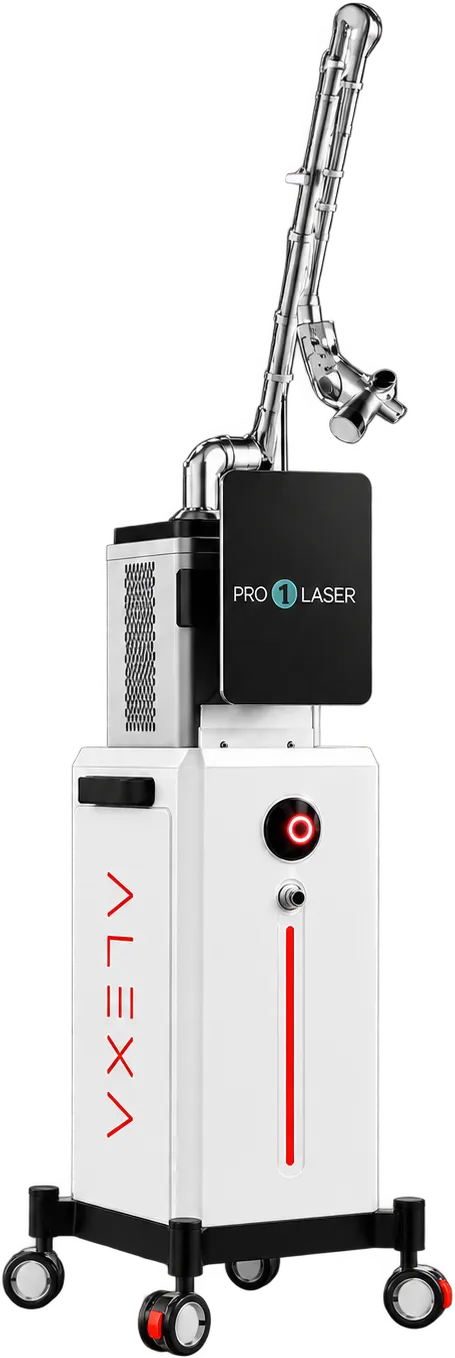
7 Reasons Why CO₂ Is the Wavelength for 2025 — And How the Pro 1 Laser Alexa CO₂ Unlocks Its Full Potential
Pro 1 Laser Team · October 23, 2026
“CO₂ isn’t just for wrinkles. From deep acne scars to surgical scar revision, this wavelength continues to evolve, and in 2025 it’s more relevant than ever.”
The 10,600 nm CO₂ wavelength has been a gold standard in dermatology and aesthetic medicine for decades. But the technology has matured far beyond simple resurfacing, especially with advanced fractional systems like the Pro 1 Laser Alexa CO₂.
Here’s why this wavelength deserves a starring role in your clinic this year.
1. Fractional and fully ablative versatility in one platform
Think of CO₂ like a surgeon’s scalpel and a fine artist’s brush: you can go deep and aggressive, or feather-light and subtle.
- Fractional mode: creates micro-ablative columns to stimulate collagen and smooth texture with faster healing.
- Fully ablative mode: ideal for severe textural damage or precise lesion removal.
Alexa advantage: moving between fractional and full ablation is seamless on the Pro 1 Laser Alexa CO₂, giving you surgical precision and aesthetic finesse in one session.
2. Superior water absorption means a predictable tissue response
At 10,600 nm, CO₂ targets water, which is abundant in skin, with surgical-level absorption. This means you can vaporize tissue with minimal lateral thermal damage when parameters are dialled in.
Clinical analogy: imagine boiling water. Once it hits 100°C, you can predict exactly when it will vaporize. The Alexa CO₂ delivers that same predictability to skin ablation.
3. A scar remodeling powerhouse
CO₂ fractional treatment remains unmatched for remodeling collagen in:
- Surgical scars
- Acne scars
- Stretch marks
- Traumatic scars
Case example: a woman, 38, with a hypertrophic C-section scar underwent 3 Alexa CO₂ fractional sessions at 4-week intervals (80 mJ, 20% density, double pass over raised tissue).
Result: scar flattening by about 60%, improved pliability and visible softening of the borders.
Why it works: controlled ablation triggers neocollagenesis and reorganizes disorganized scar fibres.
4. Refined texture, with downtime you can measure
A 10-day recovery isn’t something every patient wants, or can tolerate. Alexa CO₂ allows:
- Low-density passes for 3-4 days of downtime: the “weekend peel”
- High-density passes for 7-10 days in aggressive scar revision
Clinical pearl: stack fractional patterns in a cross-hatch to treat more tissue without pushing density too high in one pass. This reduces the risk of prolonged erythema.
5. Adjustable spot sizes for every job
From pinpoint surgical excision (0.2 mm) to wide-area resurfacing (up to 1.5 mm), spot size control means:
- More consistent penetration depth
- Faster coverage on large surfaces
- Precision on delicate areas like eyelids
Analogy: it’s like having multiple paintbrushes in one hand: broad strokes for the background, a fine tip for details. Customizable scan shapes cover a fractional treatment area of up to 30 mm.
6. CO₂ as a surgical and aesthetic hybrid
The Alexa CO₂ isn’t just about resurfacing. It’s a surgical-grade tool for:
- Excision of benign lesions
- Blepharoplasty skin tightening
- Gingival and ENT soft-tissue work
Clinic edge: this dual capability means a higher device ROI and broader patient indications. Alexa Femme™ extends the platform into women’s wellness, and Alexa Follicle™ adds a scalp pathway for hair restoration.
7. The 2025 advantage: pairing with adjunctive technologies
In 2025, CO₂ isn’t a solo act. Combine Alexa CO₂ with:
- Pico laser (such as the Pro 1 Pico): for pigment refinement after CO₂
- RF microneedling: for deeper dermal tightening alongside surface smoothing
- Platelet-rich plasma (PRP): to speed recovery and enhance collagen synthesis
Protocol example: scar patients receive Alexa CO₂ followed by a PRP infusion in the same visit, reducing downtime by about 2 days and improving texture outcomes.
Clinical endpoint guide
| Endpoint | Action | What you see |
|---|---|---|
| Ideal | Keep current settings | Faint erythema around even micro-ablative columns, no charring |
| Overtreatment | Lower fluence or density | Charred tissue, prolonged oozing |
| Undertreatment | Fluence probably too low | Little frosting and no erythema |
Final takeaway
In 2025 the Pro 1 Laser Alexa CO₂ is still one of the most versatile, ROI-positive devices a clinic can own, because it can:
- Switch between fractional and fully ablative modes
- Remodel scars with measurable improvements
- Fine-tune downtime for patient needs
- Act as both a surgical and an aesthetic tool
- Integrate seamlessly into multi-modal treatment plans
Whether you’re treating a 22-year-old with rolling acne scars or a 60-year-old seeking full-face rejuvenation, the Alexa CO₂ delivers precision, safety and results you can count on. It comes in 40 W or 60 W (Alexa Pro MVP 7) versions and holds FDA clearance and a Health Canada licence.
Frequently asked questions
In 2025, why is 10,600 nm CO₂ still the gold standard? It offers unmatched water absorption, allowing precise ablation with minimal thermal damage. It effectively treats wrinkles, scars and skin laxity while enabling both surgical and aesthetic applications.
What makes the Pro 1 Laser Alexa CO₂ different from other CO₂ lasers? It combines fractional and fully ablative capabilities in one system, with adjustable spot sizes, customizable downtime and surgical-grade precision, maximizing versatility and ROI for clinics.
Can the Alexa CO₂ treat scars effectively? Yes. Fractional CO₂ treatment with Alexa stimulates collagen remodeling, flattens raised scars, softens borders and improves skin texture, delivering noticeable results in as few as three sessions.
How does pairing Alexa CO₂ with other treatments improve results? Combining it with PRP, RF microneedling or pico laser enhances collagen production, speeds recovery and delivers more comprehensive aesthetic improvements.
Want to see the Alexa CO₂ at work? Book a demo with Pro 1 Laser.